
No products
Scanners
Online only
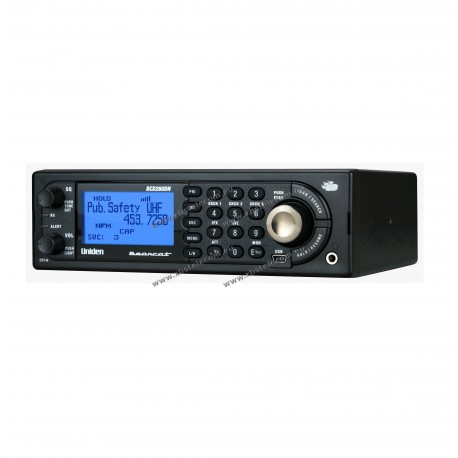
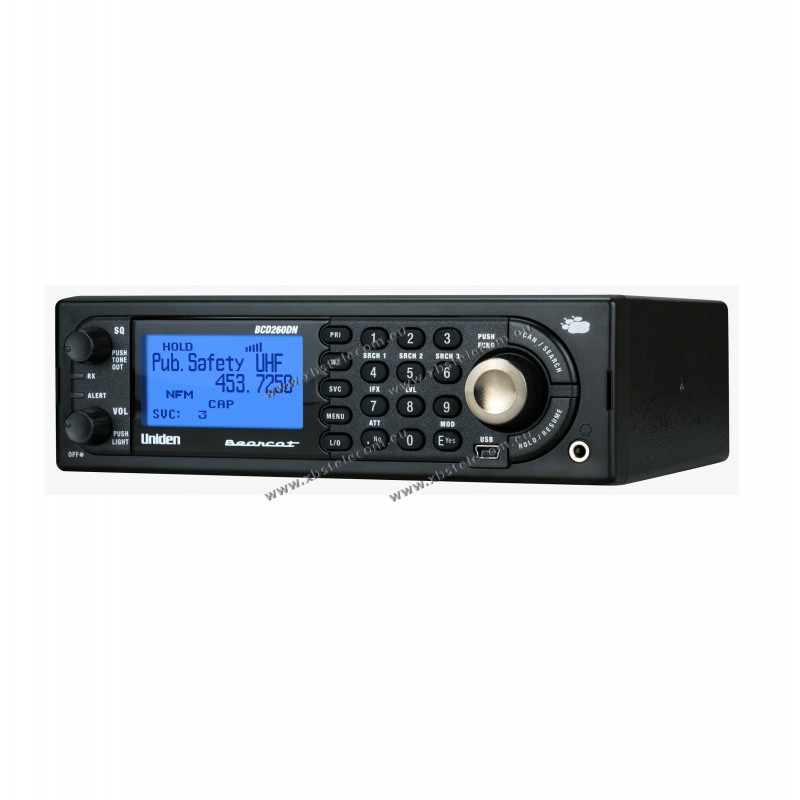
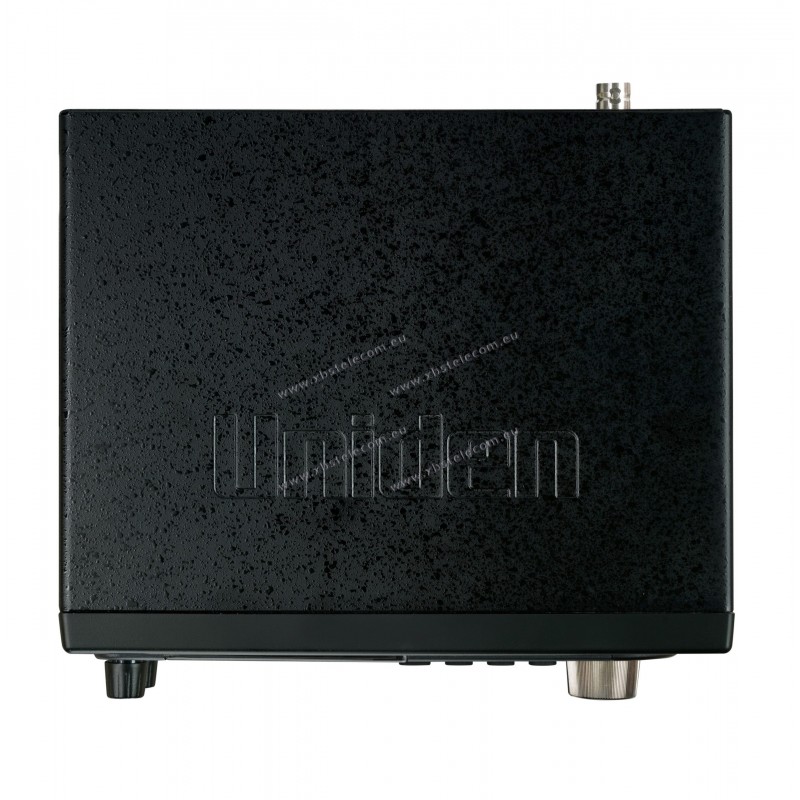
UNIDEN BEARCAT - UBCD260DN - Scanner Digital
50633650981
New product
DMR, NXDN and dPMR Analogue and Digital Scanner
By buying this product you can collect up to 4 loyalty points. Your cart will total 4 loyalty points that can be converted into a voucher of 4,00 €.
 Pay it by wire
and save an additional 3,39 €
More info
UNIDEN UBCD-260DN
DMR, NXDN and dPMR Analogue and Digital Scanner
The Uniden UBCD-260DN is a powerful, modern and versatile receiver scanner designed for radio amateurs, radio monitoring enthusiasts and users wishing to explore a wide part of the VHF, UHF and higher-frequency spectrum.
With analogue and digital reception modes, fast scanning, extensive search functions and a capacity of 1,000 memory channels, it provides a complete compact monitoring station suitable for both fixed and mobile installations.
The UBCD-260DN supports DMR, NXDN and dPMR digital modes as standard. It can therefore receive many compatible, non-encrypted digital communications without requiring an additional decoding module or optional software licence.
However, this model does not support Trunking systems and does not decode APCO-25, also known as P25.
A complete scanner for exploring the radio spectrum
The Uniden UBCD-260DN can monitor a wide variety of radio communications, subject to the regulations applicable in the country where it is used.
Depending on local frequency availability and legal restrictions, it may be used to monitor:
- amateur radio bands;
- civil aviation communications;
- marine communications;
- railway communications;
- CB radio;
- FM broadcasting;
- certain analogue or digital professional networks;
- certain non-encrypted communication services;
- many other transmissions using compatible modes.
According to the specifications provided for this version, the scanner covers the following frequency ranges:
- 25 to 520 MHz;
- 758 to 960 MHz;
- 1240 to 1300 MHz.
This wide frequency coverage brings together many of the bands commonly monitored by radio enthusiasts in a single unit.
Actual frequency coverage, channel steps and pre-programmed service searches may vary according to the regional version, firmware and country of sale.
Analogue and digital reception
The UBCD-260DN supports several analogue and digital modulation types.
Analogue modes
- AM;
- FM;
- narrow FM;
- wide FM;
- FM broadcast reception.
Digital modes
- DMR;
- NXDN;
- dPMR.
These digital modes are already installed in the scanner. No additional purchase should normally be required to decode compatible, non-encrypted transmissions.
The scanner can also detect and display useful technical information, including:
- CTCSS tones;
- DCS codes;
- DMR Color Codes;
- NXDN areas;
- NXDN RAN codes.
When an active frequency is detected, the UBCD-260DN can automatically search for the tone or code being used. This greatly simplifies the identification and programming of unknown radio systems.
Important compatibility limitations
The Uniden UBCD-260DN cannot receive or decode every type of radio network.
The following limitations must be taken into account:
- it cannot decode encrypted communications;
- it does not support Trunking system tracking;
- it does not decode APCO-25/P25;
- it cannot bypass encryption;
- compatibility with proprietary systems is not guaranteed;
- compatibility with every variation of a digital protocol is not guaranteed;
- the fact that a frequency is covered by the scanner does not automatically mean that the transmission can be decoded.
A DMR or NXDN network may, for example, use a Trunking architecture, encryption, a proprietary configuration or parameters that are not supported by the scanner.
In such cases, reception may be impossible or incomplete even though the general digital protocol is listed as compatible.
Fast searching and high-speed scanning
The UBCD-260DN is designed to detect radio activity quickly.
Its stated scanning speed is approximately 85 channels per second, with higher speeds possible in certain search modes.
The Turbo Search feature can increase the search speed to approximately 300 steps per second on certain bands using a 5 kHz channel step.
This speed is particularly useful for:
- exploring a frequency band;
- searching for an unknown frequency;
- detecting local radio activity;
- identifying a repeater;
- finding occasional transmissions;
- rapidly scanning a large channel list.
The quick-search function allows a search to be started from:
- the currently displayed frequency;
- a stored channel;
- a manually entered frequency.
The control knob can then be used to change the search direction.
Band Scope function
The Band Scope mode is one of the most interesting features of the Uniden UBCD-260DN.
It provides a visual indication of activity within a selected frequency range and displays the relative strength of detected signals.
The scanner searches from the lowest frequency to the highest frequency in the selected range. It can also display the strongest signal found in that band.
This function can be useful for:
- quickly locating an active frequency;
- observing band occupancy;
- comparing several signals;
- searching for a nearby transmission;
- identifying a local transmitter or repeater;
- monitoring activity around a known frequency.
For radio amateurs and experienced monitoring enthusiasts, the Band Scope provides a very practical visual tool for spectrum exploration.
1,000 memory channels
The UBCD-260DN can store up to 1,000 frequencies, arranged in 10 banks of 100 channels.
This structure allows users to organise frequencies according to their own requirements.
For example, separate banks may be created for:
- VHF amateur radio repeaters;
- UHF amateur radio repeaters;
- aviation frequencies;
- marine channels;
- digital systems;
- railway frequencies;
- local frequencies;
- priority channels.
Each channel can be given an alphanumeric name of up to 16 characters.
Instead of displaying only a frequency, the scanner can therefore show a clear channel name, such as:
- VHF REPEATER;
- AIR APPROACH;
- LOCAL PORT;
- LOCAL DMR;
- RADIO CLUB;
- MARINE 16.
The scanner can also warn the user when a frequency or name has already been stored, reducing unnecessary duplicate entries.
Ten custom searches
The UBCD-260DN allows up to 10 custom search ranges to be programmed.
Each range can be adapted to a specific radio activity or section of spectrum.
Depending on the available settings, the user may define:
- the starting frequency;
- the ending frequency;
- the frequency step;
- the modulation;
- the search delay;
- attenuation;
- frequencies to be skipped.
This function is ideal for concentrating the search on a specific band without wasting time on unwanted frequencies.
Twenty-six service searches
The scanner includes 26 pre-programmed service searches.
Depending on the regional version and frequency plan, these searches may include:
- amateur radio;
- civil aviation;
- military aviation;
- marine communications;
- railway communications;
- CB radio;
- FM broadcasting;
- media;
- motor racing communications;
- certain professional services;
- certain public safety or emergency services;
- FRS and GMRS services mainly used in North America.
These pre-programmed searches allow users to start exploring the radio spectrum without immediately programming every frequency range manually.
Some service categories are intended for the North American market and may have little or no practical use in Europe.
Three quick-search keys
Three numeric keys can be assigned to frequently used search functions.
They may be configured for functions such as:
- a custom search;
- a service search;
- a tone search;
- Band Scope mode;
- weather monitoring;
- another compatible function.
These shortcuts provide fast access without navigating through several menu levels.
CTCSS and DCS decoding
The UBCD-260DN can detect, decode and display CTCSS tones and DCS codes used on many analogue radio systems.
This function is particularly useful for:
- identifying repeater parameters;
- separating several user groups on one frequency;
- reducing unwanted squelch openings;
- programming channels found during a search.
The scanner can also automatically search for an unknown tone or code when an active frequency is detected.
Digital parameter detection
For compatible digital transmissions, the scanner can search for and display technical information such as:
- DMR Color Code;
- NXDN area;
- NXDN RAN code.
This information helps users identify and organise received digital systems.
However, detecting these parameters does not guarantee that the entire network can be followed or decoded.
Configurable band settings
The UBCD-260DN allows reception settings to be customised for different frequency bands.
Available channel steps include:
- 5 kHz;
- 6.25 kHz;
- 7.5 kHz;
- 8.33 kHz;
- 10 kHz;
- 12.5 kHz;
- 15 kHz;
- 20 kHz;
- 25 kHz;
- 50 kHz;
- 100 kHz.
The 8.33 kHz step is used for certain VHF aviation communications.
Depending on the selected band, the user can also choose a compatible modulation mode:
- AM;
- FM;
- NFM;
- WFM;
- FM broadcast.
These settings allow the scanner to be accurately adapted to the type of transmission being monitored.
20 dB attenuator
The scanner includes an attenuator that reduces incoming signal strength by approximately 20 dB.
It can be applied to an individual channel or a search range.
This function is particularly useful:
- near a powerful transmitter;
- in an urban environment;
- close to a broadcasting site;
- when using a high-gain external antenna;
- when the receiver is overloaded;
- when unwanted signals or images are present.
The attenuator may improve reception when the scanner input is being overloaded by very strong signals.
Intermediate frequency shift
The UBCD-260DN includes an intermediate frequency shift function.
This changes the intermediate frequency used for a selected channel or frequency in order to reduce certain internally generated interference products, images or mixer outputs.
It may be especially useful when a frequency appears to be affected by a false or internally generated signal.
Broadcast filter
A broadcast filter helps reduce unwanted stops on certain powerful broadcast or paging frequencies.
During a search, this feature allows the scanner to ignore known unwanted signals and continue searching more efficiently.
It can be particularly useful in urban areas or close to high-power transmitters.
Adjustable search and scan delays
After a transmission ends, the scanner can remain on the frequency for a short period to wait for a reply.
The delay can be set to approximately 30 seconds, depending on the channel or search mode.
A forced resume time of up to approximately 10 seconds can also be programmed.
These settings allow the scanner to be adapted to different types of radio traffic.
A short delay may be suitable for very busy systems, while a longer delay can help follow conversations with pauses between users.
Priority channels
Selected channels can be marked as priority channels.
During normal scanning, the scanner checks these channels regularly to reduce the risk of missing important activity.
The Priority Plus mode monitors priority channels only.
This function is useful for monitoring:
- a local amateur radio repeater;
- a calling frequency;
- a radio club channel;
- an aviation frequency;
- a marine channel;
- any frequency considered important.
Temporary and permanent lockout
During scanning or searching, some frequencies may be continuously active, noisy or of no interest.
The scanner can lock out up to 400 frequencies, including:
- 200 temporary lockouts;
- 200 permanent lockouts.
Temporarily locked-out frequencies are automatically restored when the scanner is restarted.
This makes it easy to skip an unwanted frequency without permanently changing the programming.
Custom sound and light alerts
The UBCD-260DN can alert the user when a particular channel, code or tone is received.
Alerts may be customised with:
- 9 sound patterns;
- 15 volume levels;
- 7 colours;
- 2 flashing patterns.
Available colours include:
- blue;
- red;
- magenta;
- green;
- cyan;
- yellow;
- white.
A different colour can therefore be assigned to each communication category.
For example:
- blue for aviation;
- green for amateur radio repeaters;
- yellow for marine communications;
- red for a priority channel.
Even at a low audio volume, the user can visually identify the type of transmission being received.
Backlit LCD and keypad
The LCD screen and keypad are backlit for easier operation in low-light conditions, at night or inside a vehicle.
The screen backlight offers several brightness levels.
A dedicated connection cable can also link the scanner lighting to the dimmer circuit of certain vehicles.
This improves operating comfort in a mobile installation.
Individual channel volume offset
The scanner allows a separate volume offset to be applied to each channel.
This compensates for differences in audio level between different systems or transmitters.
It reduces the need to adjust the main volume control whenever one transmission is much louder or quieter than another.
Automatic gain control
The UBCD-260DN includes automatic gain control for analogue and digital signals.
This helps maintain a more consistent audio level when monitoring transmissions with different signal or modulation levels.
It improves listening comfort during extended monitoring sessions or when scanning several different types of radio network.
On-screen signal-strength meter
A signal-strength indicator is displayed on the screen.
This meter can be used to:
- compare several signals;
- evaluate reception quality;
- observe variations in a mobile signal;
- compare antennas;
- find the best position for an antenna.
Combined with the Band Scope, it provides a useful tool for analysing local radio activity.
Two-tone sequence monitoring
The scanner can monitor a sequence consisting of two audio tones.
Up to 10 configurations can be programmed with different frequency and tone settings.
When a matching sequence is detected, the scanner can generate an alert.
The UBCD-260DN can also search for and display unknown tones.
SAME weather alerts
The scanner supports SAME weather alerts broadcast on NOAA weather channels, with programmable FIPS codes.
This feature is mainly intended for the North American market.
European weather frequencies, warning systems and procedures are different, so this function may have no practical use in some countries.
Computer programming
The UBCD-260DN can be connected to a computer through its Mini-USB port.
Depending on the scanner version and software used, compatible software may allow users to:
- transfer frequencies;
- edit channel names;
- reorganise memory banks;
- save a configuration;
- restore programming;
- prepare different profiles;
- manage large frequency lists more easily;
- control certain scanner functions;
- install available updates.
The software listed for this product range is BCDX60DN SS.
Compatibility should be checked with the exact European scanner version and the operating system of the computer being used.
Audio output for recording
The scanner includes an audio output that can be connected to a recorder or a computer audio input.
Received audio may therefore be recorded, subject to applicable laws and regulations.
A VOX-controlled recorder can automatically start recording when audio is detected.
This can reduce long silent sections in recordings.
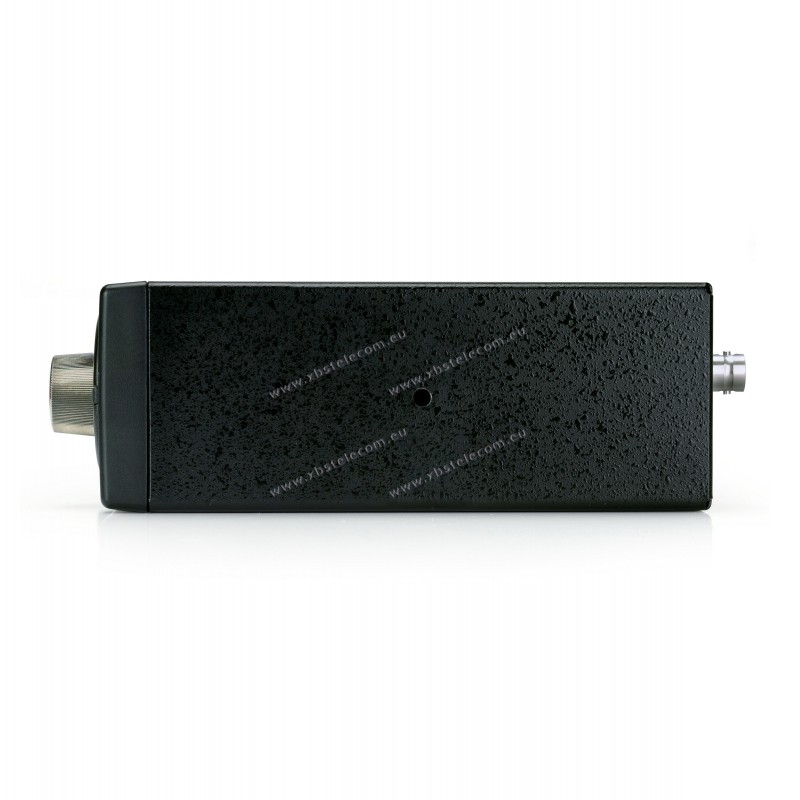
Fixed or mobile installation
With dimensions of approximately 184 × 151 × 56 mm, excluding the antenna, the UBCD-260DN can be installed:
- on a desk;
- in a radio station;
- in a technical room;
- in a vehicle;
- on a mobile console.
Its stated weight is approximately 1.5 kg.
The scanner can be installed in many vehicles using the supplied mounting bracket or a compatible DIN-E or ISO solution.
Its stated power-supply range is 11.0 to 16.6 V DC.
The DC connector is a 5.5 mm centre-positive type.
Before installation, the following should be checked:
- supply voltage;
- connector polarity;
- required current;
- suitable fuse protection;
- correct grounding;
- safe cable routing.
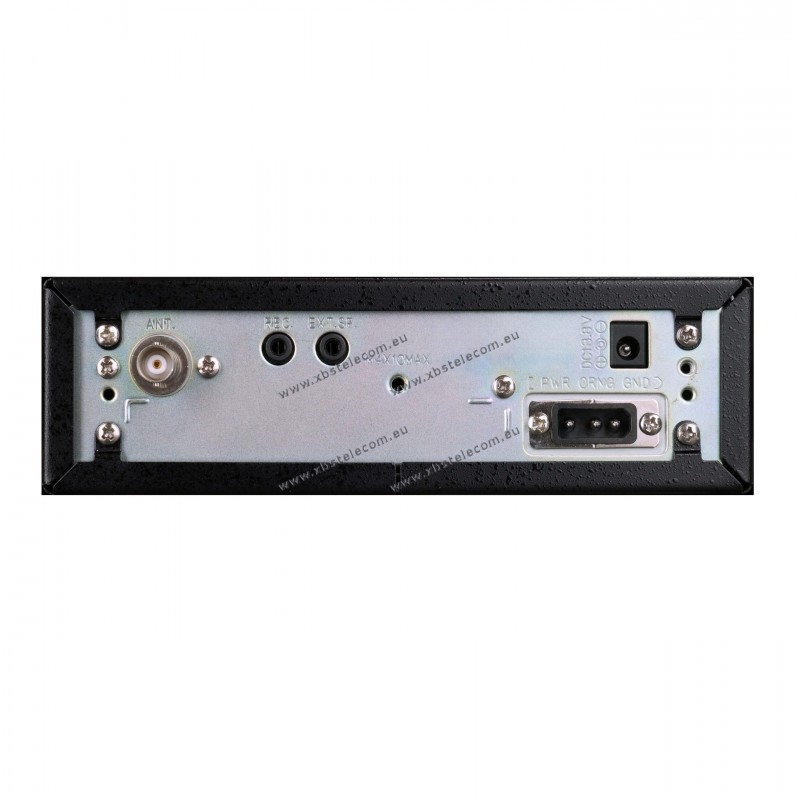
Connections
The UBCD-260DN includes the following connections:
- BNC female antenna connector;
- 3.5 mm headphone socket;
- Mini-USB port;
- DC power socket;
- audio output suitable for recording.
The BNC connector allows a wide range of antennas, adapters and coaxial cables to be used.
The importance of the antenna
As with any scanner, reception performance depends heavily on the antenna being used.
The supplied telescopic antenna allows immediate operation, but a more suitable antenna may significantly improve reception.
Depending on the user’s requirements, suitable options may include:
- a wideband discone antenna;
- a VHF/UHF vertical antenna;
- a dedicated aviation-band antenna;
- a magnetic mobile antenna;
- a directional antenna;
- an outdoor antenna installed at a greater height.
However, a wideband outdoor antenna may also increase the level of very strong signals and overload the scanner.
In this situation, the built-in attenuator or an external filter may be required.
Package contents
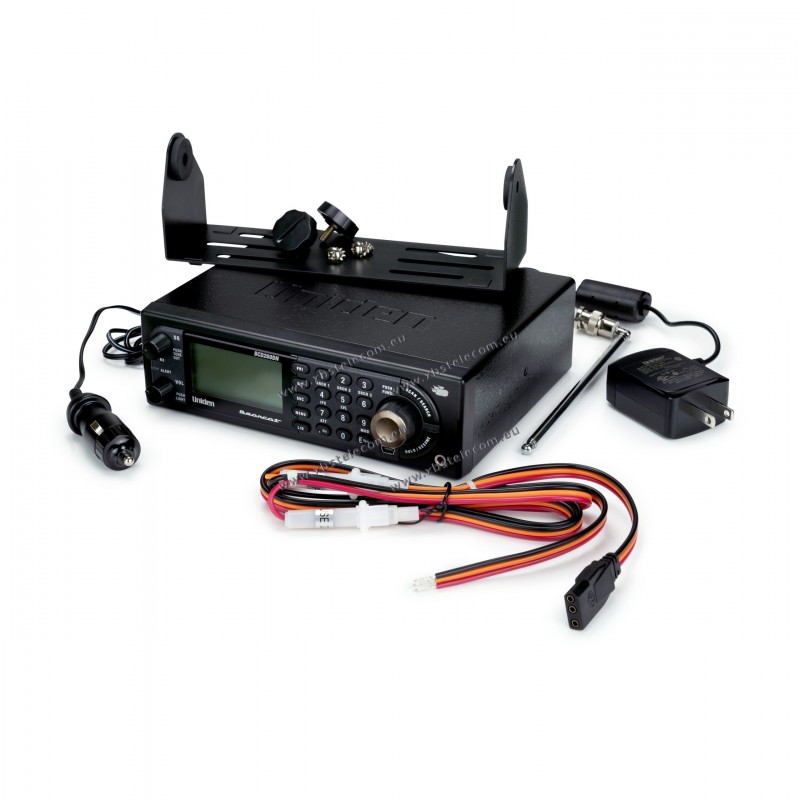
The package is stated to include:
- Uniden UBCD-260DN scanner;
- mounting bracket;
- mounting hardware;
- 12 V vehicle power cable;
- three-wire connection cable;
- USB cable;
- AC power adapter;
- telescopic antenna;
- English-language manual.
French, English and Spanish documentation is stated to be available for download from your XBS TELECOM customer account.
Information from a manual intended for the US market may also be useful for understanding the scanner’s general operation.
However, differences may exist between European and US versions, particularly regarding:
- frequency ranges;
- service searches;
- weather functions;
- band plans;
- pre-programmed services;
- certain regional features.
Main technical specifications
Model: Uniden UBCD-260DN
Type: analogue and digital receiver scanner
Stated frequency coverage: 25 to 520 MHz, 758 to 960 MHz and 1240 to 1300 MHz
Analogue modes: AM, FM, NFM and WFM
Digital modes: DMR, NXDN and dPMR
Trunking: not supported
APCO-25/P25: not supported
Encrypted communications: cannot be decoded
Memory: 1,000 channels
Banks: 10 banks of 100 channels
Custom searches: 10
Service searches: 26
Frequency steps: 5, 6.25, 7.5, 8.33, 10, 12.5, 15, 20, 25, 50 or 100 kHz
Stated scan rate: approximately 85 channels per second
Turbo Search: up to approximately 300 steps per second on certain bands
Analogue code decoding: CTCSS and DCS
Displayed digital information: DMR Color Code, NXDN area and NXDN RAN
Display: backlit LCD
Signal indication: on-screen signal-strength meter
Alerts: custom sound and multicolour light alerts
Attenuator: approximately 20 dB
Antenna connector: BNC female
Headphone socket: 3.5 mm
Computer connection: Mini-USB
Power supply: 11.0 to 16.6 V DC
Power connector: 5.5 mm, centre positive
Dimensions: approximately 184 × 151 × 56 mm, excluding antenna
Weight: approximately 1.5 kg
Who is the Uniden UBCD-260DN designed for?
Radio amateurs
It can monitor compatible analogue and digital repeaters, identify CTCSS and DCS parameters, explore amateur radio bands and follow local radio activity.
It is a receiver only and cannot transmit.
Aviation enthusiasts
AM reception and the 8.33 kHz channel step make it suitable for monitoring many compatible aviation communications, subject to local coverage and applicable regulations.
Marine-radio enthusiasts
Its search functions and VHF coverage can be used to explore marine channels available in the user’s area.
Digital-radio monitoring enthusiasts
Built-in DMR, NXDN and dPMR support is a major advantage for exploring conventional, non-encrypted digital networks.
Mobile users
Its size, mounting bracket and 12 V power supply make it suitable for vehicle installation.
Motivated beginners
Pre-programmed service searches make it easy to get started, while advanced settings provide considerable room for progression.
Essential points before purchasing
The UBCD-260DN is a receiver only. It cannot transmit.
It cannot decode:
- encrypted communications;
- Trunking networks;
- APCO-25/P25;
- unsupported proprietary systems;
- transmissions using an incompatible modulation mode.
Some functions are intended mainly for the North American market and may not be usable in Europe.
The fact that a frequency falls within the scanner’s frequency coverage does not guarantee reception.
To be received successfully, a transmission must generally:
- be within a covered frequency range;
- use a compatible mode;
- be strong enough at the receiving location;
- not be encrypted;
- not use an unsupported Trunking system;
- not use APCO-25/P25;
- reach the receiving antenna under suitable propagation conditions.
Reception conditions
Reception of a station, network or transmission type can never be guaranteed.
Reception depends on factors including:
- distance from the transmitter;
- transmitter power;
- antenna height;
- terrain;
- buildings;
- natural or artificial obstacles;
- radio propagation;
- atmospheric conditions;
- frequency band;
- antenna type and location;
- coaxial cable quality;
- connector and cable losses;
- interference;
- nearby transmissions;
- local noise level;
- modulation type;
- protocol;
- possible encryption;
- actual compatibility with the scanner.
A station that is too distant, too weak, obstructed by terrain or using an incompatible mode may be impossible to receive even when its frequency is theoretically covered by the scanner.
Failure to receive a particular service does not necessarily indicate a fault with the product.
Our opinion
The Uniden UBCD-260DN is an attractive scanner for users looking for a versatile and fast receiver capable of monitoring both analogue signals and several modern digital standards.
Its main advantages include:
- DMR, NXDN and dPMR already included;
- 1,000 memory channels;
- Band Scope;
- custom searches;
- service searches;
- CTCSS and DCS detection;
- digital parameter display;
- fast scanning;
- custom alerts;
- computer programming;
- fixed or mobile installation;
- BNC antenna connector;
- extensive reception settings.
It is suitable both for beginners discovering radio scanning and for experienced users looking for a compact and highly configurable receiver.
Users must nevertheless remember that it does not support Trunking, APCO-25/P25 or encrypted communications.
Conclusion
The Uniden UBCD-260DN is far more than a basic frequency scanner.
It provides a complete monitoring station capable of searching, storing, organising and analysing many compatible analogue and digital signals.
Its wide frequency coverage, fast searching, 1,000 memory channels, Band Scope, automatic code detection and DMR, NXDN and dPMR compatibility make it highly attractive to radio amateurs and radio communications enthusiasts.
Whether installed on a desk, in a radio station or in a vehicle, it allows users to explore the surrounding radio environment quickly and accurately.
For users seeking a modern, expandable and comprehensive scanner, while fully understanding its compatibility limitations, the UBCD-260DN represents a particularly convincing choice.
Disclaimer and limitation of liability
The information, specifications, functions, accessories, illustrations and descriptions contained in this document are provided for information only and are non-contractual.
Although every effort has been made to prepare this product description carefully, errors, omissions, inaccuracies, translation differences or variations between product versions may remain.
To the extent permitted by applicable law, XBS TELECOM cannot be held responsible for any errors, omissions or inaccuracies contained in this description.
Technical specifications, functions, accessories, software, frequency coverage, menus, firmware, package contents and documentation may be changed, replaced or withdrawn by the manufacturer without prior notice or prior publication.
Any photographs or illustrations used are non-contractual.
XBS TELECOM does not guarantee reception of any particular station, network, repeater or type of transmission.
XBS TELECOM cannot be held responsible if the user is unable to receive:
- a station that is too far away;
- a signal that is too weak;
- a transmission blocked by terrain or buildings;
- an interfered transmission;
- an encrypted network;
- a Trunking network;
- an APCO-25/P25 transmission;
- a proprietary protocol;
- a transmission using a mode that is not compatible with the scanner;
- a transmission requiring a function that is unavailable on the supplied scanner version.
Failure to receive a particular transmission does not necessarily indicate a fault with the product.
Before placing an order, the purchaser must ensure that the scanner’s frequency bands, analogue and digital modes, functions and limitations meet their requirements.
The scanner must be used in accordance with the regulations applicable in the country concerned. Some communications may be technically receivable even though listening to, recording, disclosing or using their content is not legally permitted.
Reviews
No customer reviews for the moment.